The adverb definition is fairly straightforward in that it's a word that qualifies, limits, describes or modifies a verb, adjective or another adverb. However, it also has the power to modify apreposition, conjunction, clause or even an entire sentence. It also has the power to modify whole phrases and clauses—there's a lot to learn about. Just remember, the definition of an adjective is that it modifies anoun. While the definition of adverb is that is modifies pretty much every other key part of speech!

Continue reading this guide and it should become clearer. You can findmore info hereand there's also some furtherrecommended readingonline for those who need more clarification. It is easy to confuse adjectives and adverbs because they are both modifiers that provide us with more information. Some words, such as slow, well, and late can even be used as either an adjective or an adverb. The main way to figure out if a word is being used as an adjective or an adverb is to check the word that it modifies.

If it is modifying a noun or a pronoun, it is an adjective. If it is modifying anything else, it is an adverb. Adjectives only modify nouns and pronouns, while adverbs modify verbs, adjectives, clauses, or other adverbs.
Many other adverbs, however, are not related to adjectives in this way; they may be derived from other words or phrases, or may be single morphemes. Examples of such adverbs in English include here, there, together, yesterday, aboard, very, almost, etc. However, modern grammarians recognize that words traditionally grouped together as adverbs serve a number of different functions. Some describe adverbs as a "catch-all" category that includes all words that do not belong to one of the other parts of speech. An adverb is a word or an expression that modifies a verb, adjective, another adverb, determiner, clause, preposition, or sentence. Adverbs typically express manner, place, time, frequency, degree, level of certainty, etc., answering questions such as how?

This is called the adverbial function, and may be performed by single words or by multi-word adverbial phrases and adverbial clauses. You could alsosee thisonline grammar handbook, which looks at the different types of prepositional phrases. Another useful online grammar resource to help with writing your papers and essays is our EasyBib Plus grammar checker. You can upload your work for free at EasyBib Plus for a quick and easy check.

In simple words, an adverb is a word that describes verbs. Adverbs are also used to add or modify the meaning of an adjective, a verb, a preposition, a sentence, a clause. We can add more information to the words, using different kinds of Adverbs. Hence, Adverbs are a part of speech and express the manner, time, place, frequency, degree, and much more about a verb. They also act as a verb phrase which includes a verb and its dependents.
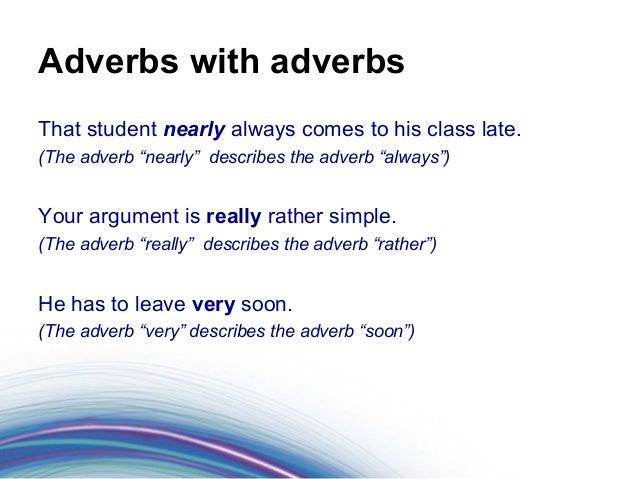
Adverbs are a major part of speech that we use to modify verbs, adjectives, clauses, and even other adverbs. If you've studied grammar, you probably know that words like calmly, everywhere, and soon are examples of adverbs. But did you know that there are different types of adverbs?
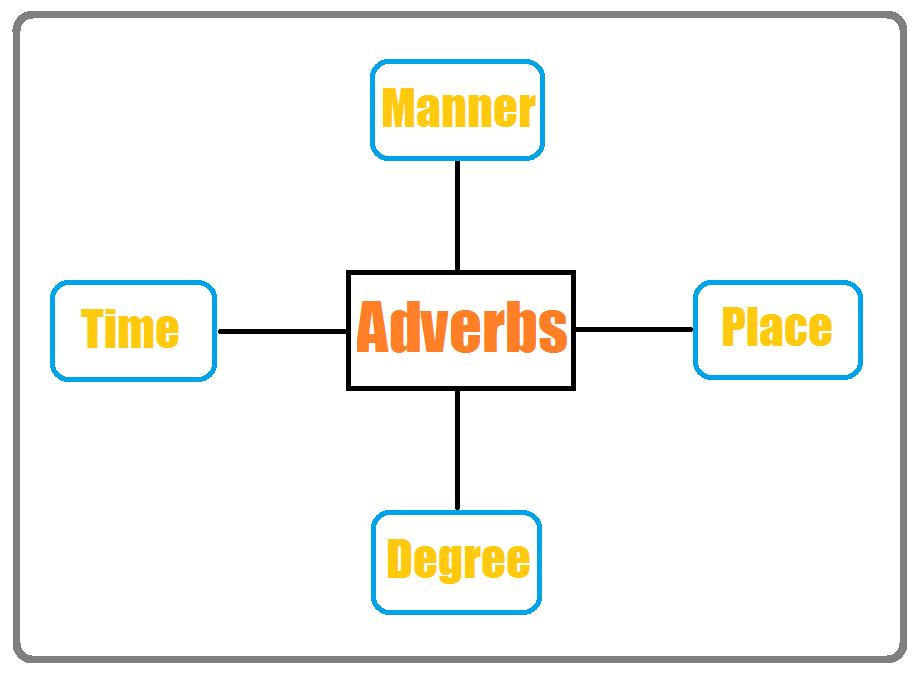
It's true, and we are going to learn how versatile adverbs can be by learning more about six common types of adverbs that we use all of the time. They are adverbs of time, adverbs of place, adverbs of degree and adverbs of manner. Adverbs of time talk about the time factor related to the verb.
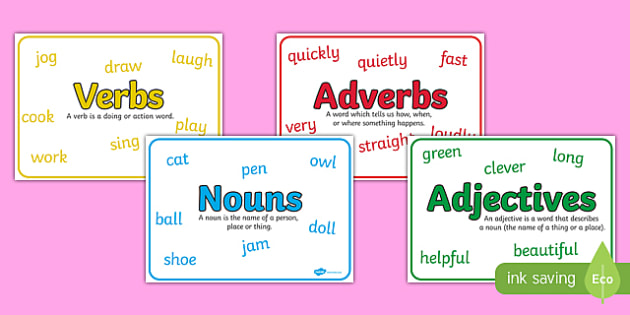
Some examples for adverbs of time are now, never, often, etc. Adverbs of place speak about the venue related to the verb. Some examples are here, there, everywhere, etc. Adverbs of degree speak about the extent to which some action was done. Partly, almost and fully are some such examples. Adverbs of manner tell in what way an action was performed.

Slowly, fast, deliberately are some examples for that. Adverbs and Adjectives are both used to modify different words in a sentence. The main difference between adverb and adjective is that adverbs modify verbs, adjectives, and other adverbs whereas adjectives modify nouns. Adjective and adverb phrases belong to their own groups.
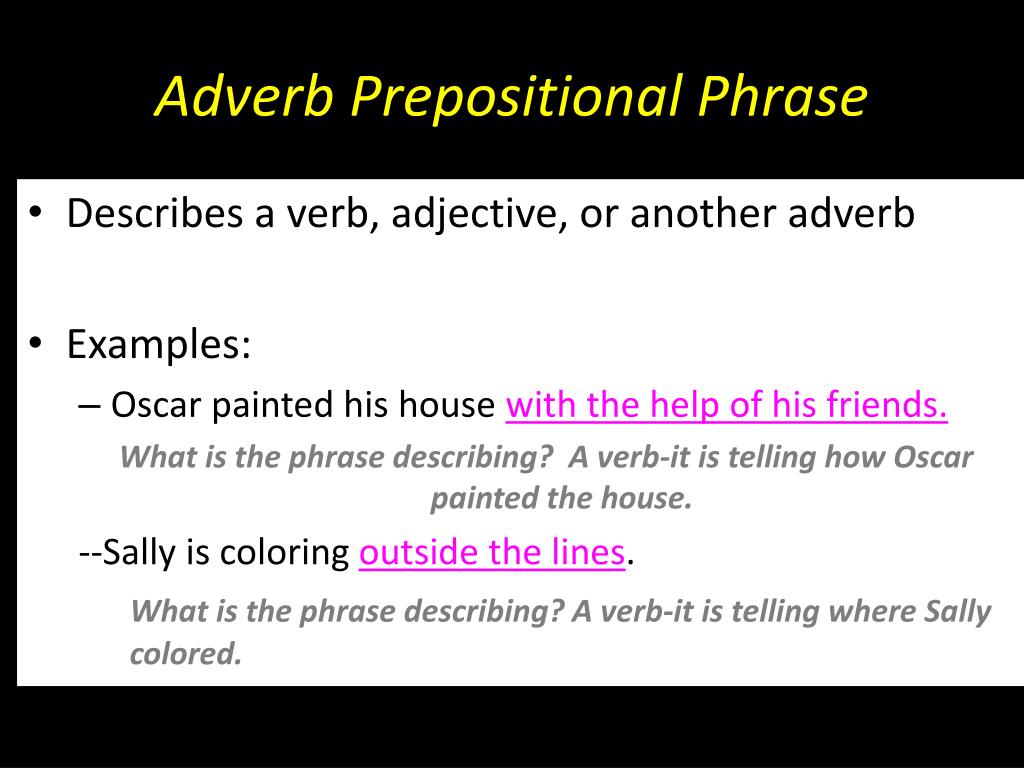
Both types of phrases are groups of words which act to modify nouns and verbs respectively. Instead of being only a single word, a phrase is made up of two or more words that modify another word. So, what's an example of an adverbs and adjectives phrase? Try to determine which of the following phrases can modify verbs, and which can modify nouns.

Remember that the adverb meaning is to modify verbs and adjectives, as well as their own word type. Nouns are strictly off this grammar guest list, so don't confuse them with noun-modifying adjectives, which perform a similar function. A good way to understand adverbs is to think about them as the words that provide context. Specifically, adverbs provide a description of how, where, when, in what manner and to what extent something is done or happens. Normally, we can spot an adverb by the fact that it often ends in –ly, but there are lots of adverbs that don't end in this way. Moreover, adverbs can be used in many combinations with each other.
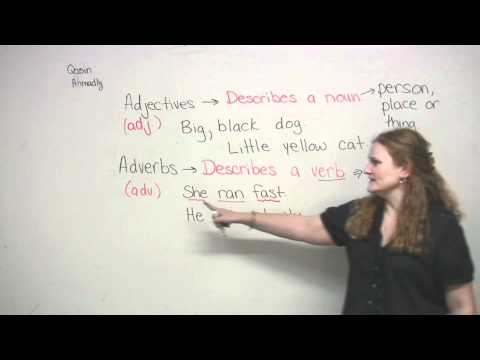
What is the difference between an adjective and an adverb? To answer this question, it's important to first answer, "What are adjectives and adverbs? " The former describes a noun, while the latter describes a verb. Well, noun-describing words give your audience more information about a person, place, or thing.

Adverbs are words that are used to give more information about verbs. They can be used to describe the action, give more information about the when, where, and how of the action, or to compare actions. Adverbs can also be used to give more information about adjectives (words that describe a noun - a person, place, or thing), or join two phrases together. Adverbs that join together two phrases are called conjunctive adverbs. Adverbs of manner — Adverbs of manner provide more information about a verb.
They mainly answer the question 'how the action is performed? Examples include swiftly, slowly, kindly, etc. Parts of speech are categories in which words with similar grammatical properties are classified. The English language has eight main parts of speech. This comprises of the noun, pronoun, verb, adjective, adverb, preposition, conjunction, and interjection. These indicate how a word functions in meaning as well as grammatically within a sentence.

A single word can function as more than one part of speech when used in different contexts. It is important to understand parts of speech to ascertain the correct meaning of a sentence. They can also modify noun phrases, prepositional phrases, or whole clauses or sentences, as in the following examples.
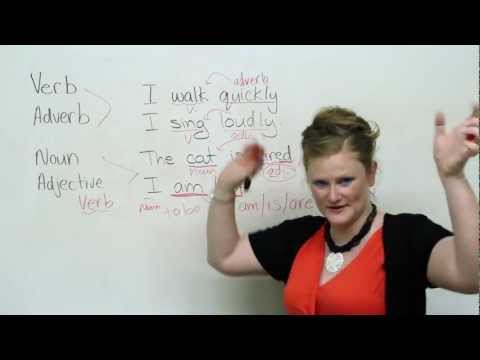
Once again the adverbs are in bold, while the words they modify are in italics. Adverbs tell us things about actions that are performed. For example, an adverb tells us when, where, how, in what manner, or to what extent an action is performed. They most commonly modify verbs, but they can also modify adjectives or other adverbs. Verb and Adverb show multiple differences between them as they are two different parts of speech.

Verb and adverb, as parts of speech, should be understood with the difference between them. Verb and adverb, each does two different tasks in the language. Remember, adjectives are words that modify nouns and pronouns. They help to describe or tell us more about those nouns and pronouns. Adverbs are words that modify verbs, adjectives, and other adverbs.

It is incorrect to say, "Probably she will leave early" or "She will leave early probably." Other such adverbs are never, rarely, seldom, and always. They usually go between the subject and the main verb. Different types of adverbs have different sentence positions. Adverbs that express the manner/approach/process of the action in the sentence are called adverbs of manner.

They answer the question 'how is the action performed? Adverbs that express the importance/degree/level of the action in the sentence are called adverbs of degree. They answer the question 'how much is the action performed?

We hope you have found this explanation about adjectives and adverbs helpful. FLS has been helping students improve their English, get accepted to outstanding universities and move up in their careers for over thirty years. If you're still looking for more help, contact us here. We would be happy to find out more about you and discuss which of our wonderful programs would be the best fit for you and your goals. Remember, adverbs are words used to give more information about verbs. They can be used to describe the action and give more information about the when, where, and how of the action.
Adverbs can also be used to compare different actions, give more information about adjectives , and join together two phrases. Several of the words on the compounds list also fall into the conjunctive adverbs category. Conjunctives can be used to join two clauses together in one sentence. However, conjunctives can also be used to join two sentences. (See what we did there?) They can be used to show a relationship between two clauses, and can make your writing flow better or seem more conversational.

An adverb is a word/a set of words that modifies verbs, adjectives, and other adverbs. It tells when, where, and how an action is performed or indicates the quality or degree of the action. There are many different grammar rules which help make up our sentences and language. E.g. they're, their and there or when to use the word too instead of to. Once you start to learn the basic rules of grammar it becomes a lot easier and will come to you naturally.

What Is The Difference Between Verb And Adverb With Examples Adverbs of purpose, sometimes called adverbs of reason, help to describe why something happened. They can come in the form of individual words – so, since, thus, because – but also clauses – so that, in order to. Notice in the examples that the adverbs of purpose are used to connect sentences that wouldn't make sense if they were formed alone. Adverbs are often formed by adding the letters "-ly" to adjectives.

This makes it very easy to identify adverbs in sentences. There are many exceptions to this rule; everywhere, nowhere, and upstairs are a few examples. An adverb is a word that describes or modifies verbs,adjectives, clauses, and other adverbs.
We use it to give additional information about other words. These words, as you'll soon discover, perform many different functions in the English language. But sometimes they are difficult to identify, as there isn't a set rule on where describing words go in a sentence.
After reading this article, you'll understand how to creatively express yourself using describing words. You'll also know how to identify when someone uses a describing word in writing or speaking. After reading this guide, check out thisinformative reference.
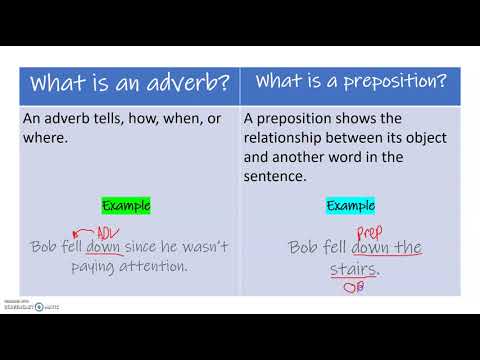
Adverbs of place tell us more about where the verb took place. Many writers confuse them with prepositions, which describe the location of nouns. While some of these words can function as prepositions, they are considered adverbs when they modify verbs. Also, prepositions are followed by objects, while adverbs of place are not. Even though you know a bit more about descriptive words, it doesn't mean it's any easier to tell if a word is an adverb or adjective. So, what is the difference between an adjective vs adverb?
Well, you can learn certain rules around the differences between adjectives and adverbs, as long as you know what are adjectives and adverbs. These rules will help you properly use both types of descriptive words without getting mixed up. Like adjectives, adverbs can show degrees of comparison, although it's slightly less common to use them this way. With certain "flat adverbs" , the comparative and superlative forms look the same as the adjective comparative and superlative forms. It's usually better to use stronger adverbs rather than relying on comparative and superlative adverbs.

The adverbs in each of the sentences above answer the question in what manner? Adverbs can answer other types of questions about how an action was performed. Adverbs are words that describe verbs, adjectives, or other adverbs. Adverbs give us more information about how something is being done or the degree to which something is true. Adverbs often end with -ly, but there are common adverbs that don't end in -ly .


No comments:
Post a Comment
Note: Only a member of this blog may post a comment.